Add or edit a towing vendor
A tow company's name, contact details and rates, how your site works out the tow cost from them, and whether the tow comes out of your instant offers.
Each towing vendor is one tow company: who to call, and what it charges. Your site uses the rates to work out the tow cost of every pickup you book with it, and, if you choose, to back the tow out of every instant offer.
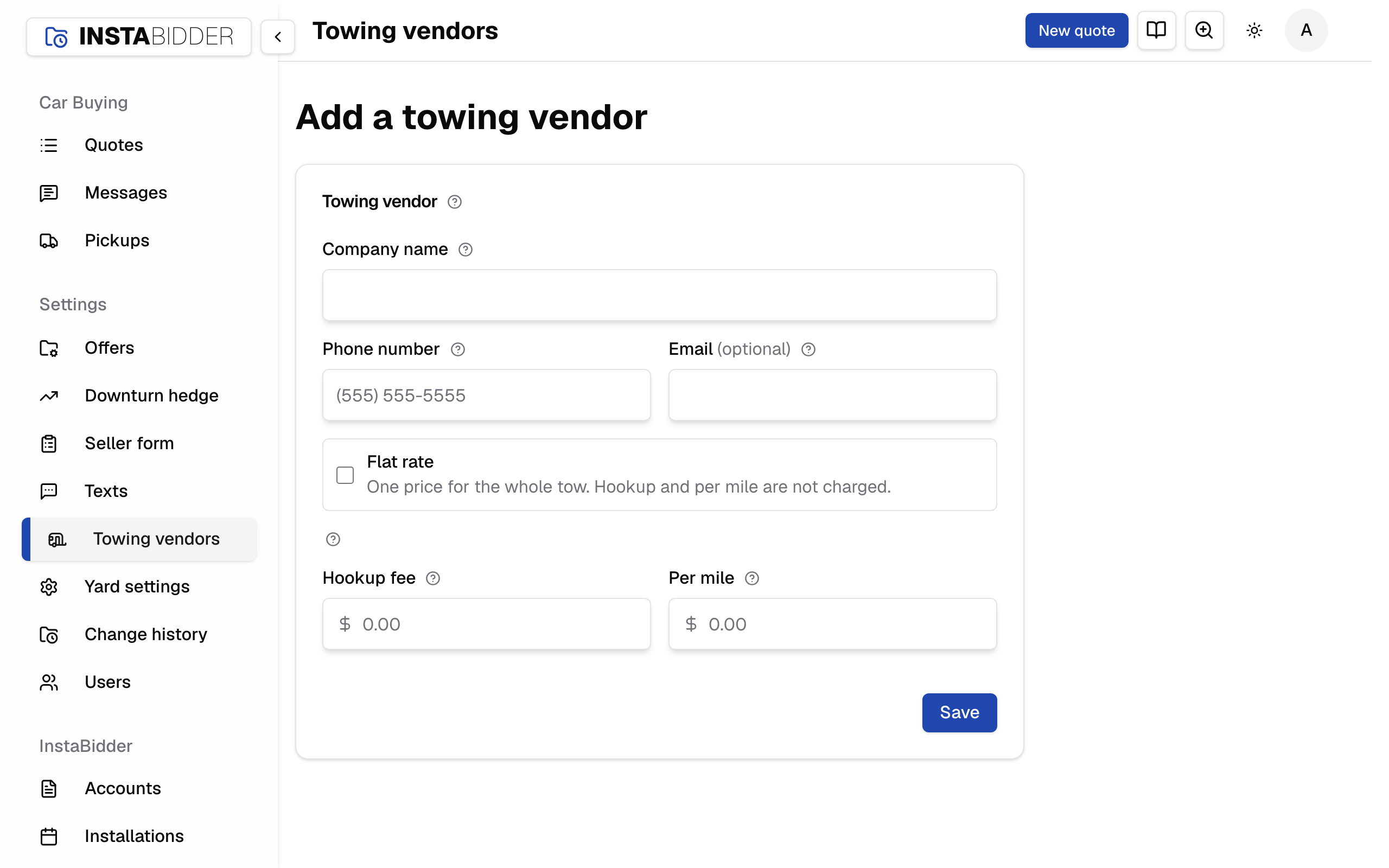
Towing vendor
One tow company: how to reach it and what it charges. Pickups booked with it use these rates to work out the tow cost.
To add one, choose Add a vendor on the Towing vendors page; the page reads Add a towing vendor. To change one, choose the pencil button on its card; the page reads Edit towing vendor. Save keeps your changes; Cancel leaves the company as it was. Every save shows in Change history under Towing.
If someone saved the company after you opened it, your save is held and the page names who; save again to replace their changes. A company someone removed meanwhile can't be saved: "That tow company was removed, so nothing was changed."
Company name
The tow company's name, as your team sees it in the list and when picking a company for a pickup. Required.
It's also the name its texts read under, in Messages and on a quote's Tow texts tab. Leaving it empty is refused: "Enter the company name."
Phone number
The number your team calls to dispatch this company, and where your site texts it about its pickups. It shows on the company's card, and tapping it calls from a phone. Required.
Enter the full number with its area code, and no extension. A number that isn't ten digits, or eleven starting with 1, is refused: "Enter a US or Canadian mobile number." Use a number that can get texts, such as dispatch's mobile: a landline can't.
Texts go to this number:
- the automatic texts to the tow company on Pickup booked or moved and Picked up, when they're on;
- a text your team sends from a quote's Tow texts tab;
- a text from the company's thread in Messages, which reads under this company's name.
Your site reads the number each time a text goes, so a change here reaches the next text, about every pickup the company has. Texts already sent stay in the old number's thread, which then shows as the number. The company's replies come back to your site's number and land with its next booked pickup. Tow company texts covers it end to end.
Leaving it empty is refused: "Enter a phone number for dispatch."
Where to reach the company in writing. It shows on the company's card. Optional.
Preferred company
Tick this on the company you usually send. Its rates price the tow backed out of an instant offer; without a preferred company, the cheapest company's rates for that trip do. One company at most: ticking it here unticks any other.
The company's card shows a star. With Back the tow out of the offer on, every offer is priced with this company's rates even when another would be cheaper that day; when its rates don't reach the seller (past its last band), the cheapest company that does prices that offer. Removing the preferred company puts the choice back to the cheapest. It doesn't pick the company on a pickup; you still choose when you book.
Rates
How the company charges: a hookup fee plus a charge per mile, one flat rate for the whole tow, or one price up to each distance. Pick one; only its boxes are charged.
- Hookup and per mile: the Hookup fee and Per mile boxes.
- Flat rate: the one Flat rate box. The company's card shows a Flat rate badge and the price.
- By distance: the Distance bands. The card shows a By distance badge and each band.
Whatever you had in the other boxes isn't charged while another choice is picked. Pick a choice again and you enter its boxes again.
Hookup fee
A charge on every tow, before the miles. It starts empty, and leaving it empty saves $0.
Enter dollars and cents, from $0 to $10,000. Anything else is refused: "Enter dollars from $0 to $10,000."
Per mile
What the company charges for each road mile, from your nearest location to the pickup. In Canada this box is Per km. Empty saves $0.
Enter dollars and cents, from $0 to $10,000. A Canadian yard types the rate per kilometre; your site keeps it per mile and shows it back per kilometre, so the figure on the card is the one you typed.
Flat rate
One price for the whole tow, however far. Empty saves $0.
Enter dollars and cents, from $0 to $10,000.
Distance bands
One price up to each distance, the way most tow companies quote: up to 20 miles is one price, up to 40 another, up to 60 another. A tow past the last band has no price, so leave the last band as far as the company goes.
Each band is a distance and a price. Enter whole road miles (kilometres in Canada), each band farther than the one above and up to 1,000, and dollars and cents from $0 to $10,000. Up to five bands; a row left wholly blank is skipped, but a distance without a price is refused: "Enter the band's price." At least one band is needed: "Enter at least one distance and its price."
A band out of order is refused: "Enter whole mi, farther than the band above and up to 1,000."
How the tow cost is worked out
For a pickup booked with this company:
- With Flat rate, the tow cost is the flat rate. Distance doesn't matter.
- With By distance, it's the price of the first band the road miles fit in: with bands up to 20 and up to 40, a pickup 20 miles away is the first band and one 21 miles away the second. Past the last band there's no price.
- Otherwise it's the Hookup fee plus the Per mile charge times the road miles from your nearest location to the pickup address, to the cent.
For example, with a $75 hookup fee and $3.50 per mile, a pickup 20 road miles away costs $75 + (20 x $3.50) = $145.
Road miles are the distance by road, the way the truck drives it, not in a straight line. If the pickup's distance can't be worked out, or it's past a company's last band, the quote shows the company's rates in place of a total, rather than a wrong number. When you choose a company for a pickup, each one is priced the same way so you can compare.
The tow cost is for your team. A seller never sees it, or any other part of how their offer was worked out.
Instant offers
Tick the box and every new instant offer is the car's value less a tow company's charge to the seller's ZIP, so the seller and the tow together cost what you'd have offered. Off, you pay the tow on top.
The card sits at the top of the Towing vendors page. With the box ticked, every new instant offer takes the road miles from your nearest location to the seller's ZIP, prices the tow the way the company's rates say (your Preferred company's, or else the cheapest company's for that trip), and takes it off the offer after your bid multiple. The quote's offer card lists it as a Towing line naming the company and what it was priced on ("Mile Marker Towing, up to 30 mi", "Last Choice Towing, 12.4 mi", "Flat Rate Towing, flat rate"), for your team only; the seller sees one number as always. A tow worth more than the car makes the offer $0.
The line is there on every offer made while the box is ticked, even when nothing came off, so you can see why: a band or flat rate you set at $0 reads "−$0.00"; a seller's ZIP that couldn't be measured reads "ZIP code couldn't be measured"; a seller farther than every company's rates reach reads "no company reaches 70 mi". None of those lowers the offer.
It needs a company to price with. Ticking the box with none is refused: "Add a tow company first: the offer backs out its cost." Offers already made keep the number the seller saw; the box changes only the offers after you save. Every save shows in Change history under Towing.
A vendor on a pickup
You pick the tow company when you book a pickup. Your site freezes that company's rates onto the pickup when it's booked. Editing a company's rates later changes the tow cost of pickups you book after that, not the ones already booked.
Remove a company
Open the ... menu on its card on the Towing vendors page and choose Remove. A removed company can't be picked for new pickups; pickups already booked with it keep it. To bring one back, add it again.